
EDITORIAL REVIEW REQUIRED — EXPRESS DRAFT. This is an unpublished draft. Some claims may be unconfirmed. Check dates, sources, claims, photographs, and video rights before publishing.
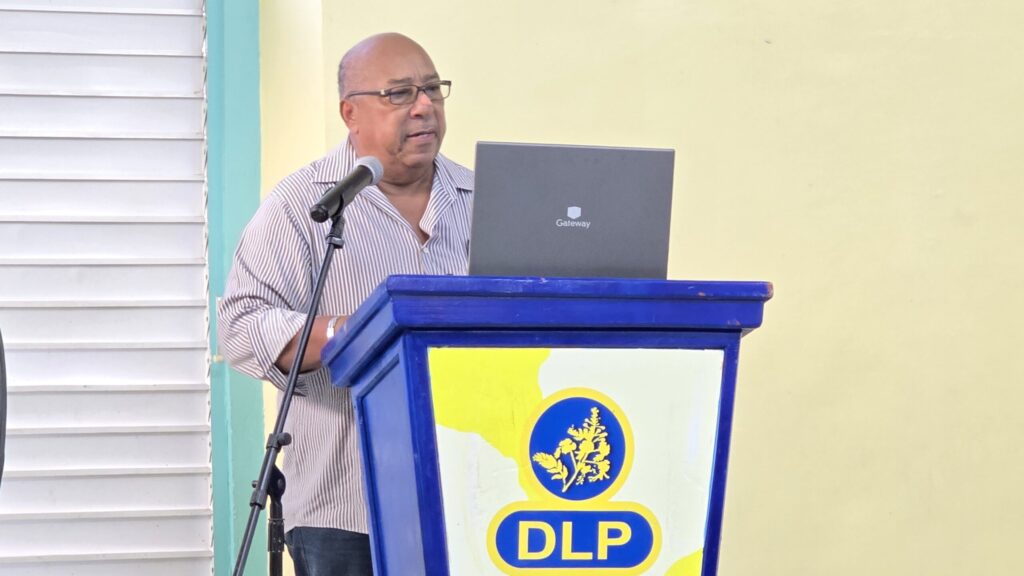
Democratic Labour Party President Dr David Estwick has outlined an ambitious economic vision for Barbados centred on state leadership rather than private-sector-driven growth. Speaking at a party meeting in St Michael East on Sunday, Estwick contended that small developing nations like Barbados face structural disadvantages in global competition that only strategic government intervention can overcome.
Estwick’s proposed framework rests on several pillars. He called for the creation of a Barbados Development and Investment Bank to finance projects that generate sustained economic activity—a departure from the current Central Bank’s limited role in government financing. He also advocated for legislation requiring public institutions such as hospitals, schools, and prisons to purchase 60 per cent of their goods from domestic suppliers, thereby anchoring government spending to local production. Additionally, Estwick proposed linking welfare payments to domestic consumption through a card-based system offering incentives for purchasing locally made goods.
The DLP leader characterised his approach as "democratic socialism" and "state-led capitalism," arguing that Barbados’ private sector is both too small and too risk-averse to absorb the graduates leaving the Barbados Community College, University of the West Indies, and Samuel Jackman Prescod Institute each year. He pointed to the State’s essential role in providing services—healthcare, transportation, housing, and infrastructure—that the private sector cannot profitably operate.
Estwick also proposed an inflation stability board comprising private-sector representatives, labour leaders, economists, and citizens to monitor price increases and trigger Central Bank intervention when thresholds are breached. He emphasised that slower inflation rates do not mean falling prices, only a slower pace of increase.
The proposal to resurrect a development bank marks a return to an earlier model. The original Barbados Development Bank, established in 1963 and operational from 1969, provided medium- and long-term financing to businesses and co-operatives across tourism, manufacturing, and agriculture before becoming insolvent and ceasing operations in 1995. The Enterprise Growth Fund Limited, created in 1998 under the Owen Arthur administration, subsequently took on the development-financing role for small and medium-sized enterprises.
Barbados has experimented with state-led development finance before. The Barbados Development Bank, created under Errol Barrow in 1963 and launched in 1969, supported key economic sectors but ultimately failed, burdened by bad debts and insolvency by 1995. The subsequent Enterprise Growth Fund Limited, established in 1998, has served as the government’s primary vehicle for financing small and medium-sized businesses.
Estwick’s proposal reflects broader Caribbean debates about economic sovereignty and development strategy in small island economies. His emphasis on domestic procurement and state-led growth echoes discussions across the region about reducing import dependency, building local productive capacity, and ensuring that government spending benefits local communities rather than overseas suppliers.
Sources and attribution
- Barbados Today
- ▶ Barbados Decent Work Country Programme 2025-2030
- multi-page.txt – World Bank Documents
- About Us – Enterprise Growth Fund Limited
- EGFL_AR2017.indd
CVCA Express Draft: verification pending; WordPress publication is manual.