
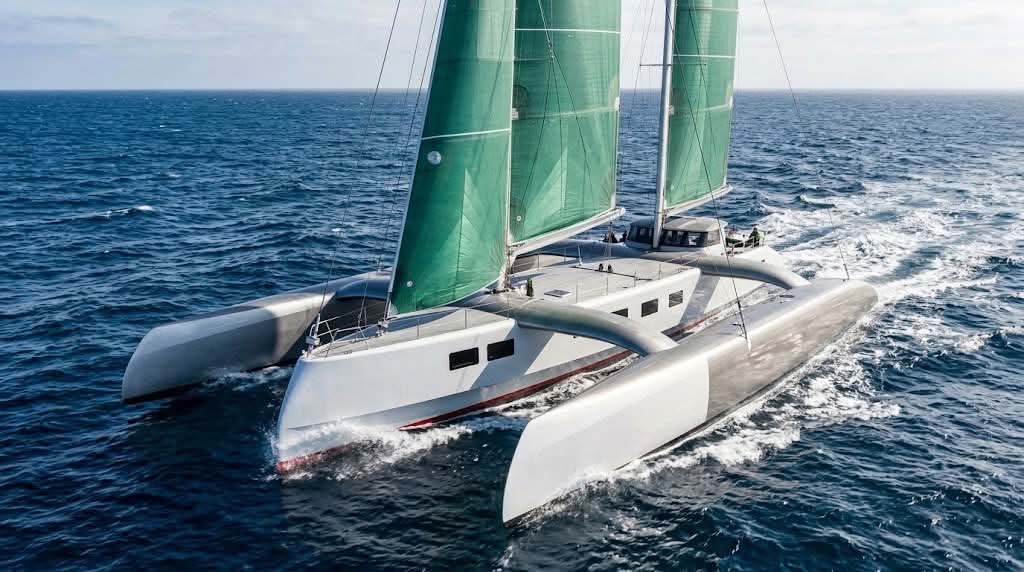
Champion Maritime Limited, trading as Alpha Zulu RoPAC, has unveiled an ambitious proposal to manufacture a new generation of environmentally friendly vessels in Barbados, according to Barbados TODAY. The company argues that despite nearly four decades of CARICOM efforts to build the legal framework for Caribbean integration, the practical movement of goods and people between island economies remains unreliable and expensive—a fundamental barrier to regional trade.
The initiative draws on the company’s experience building the schooner SV Ruth, which launched from Browne’s Beach in 2014 and subsequently operated throughout the Eastern Caribbean. Company director Ian Dash explained that this earlier project provided the foundation for developing a contemporary approach to inter-island transport. The proposed Alpha Zulu RoPAC vessels would be small, wind-primary, sail-electric ships specifically designed around Caribbean geography, cargo volumes, and trade economics.
Dash emphasized that the region’s most abundant marine resource—the trade wind—remains underutilized. The vessels would combine wind propulsion with electric propulsion, batteries, solar generation, refrigerated and palletised cargo capability, and digital logistics systems. RoPAC stands for passengers and roll-on palletised cargo, while Alpha Zulu represents the project’s objective of absolute zero fossil fuel emissions. According to Dash, reliability matters more than occasional capacity: a farmer cannot confidently expand production without knowing when ships will arrive, and small entrepreneurs cannot build regional customer bases without dependable delivery schedules.
The company is conducting a market survey asking Caribbean businesses a straightforward question: if a ship arrived weekly, what would they ship out or bring in? This approach aims to establish evidence of existing, suppressed, and potentially induced demand that current freight statistics cannot capture. Dash acknowledged the financing challenge of measuring cargo that is not currently being shipped precisely because reliable transport does not exist.
Dash’s longer-term vision extends far beyond a handful of routes from Barbados. He envisions 100 Alpha Zulu RoPAC vessels, with six commissioned annually from a Barbados factory, operating as an interconnected maritime network rather than traditional ferry services. This network would eventually link the Greater and Lesser Antilles, including Cuba, Jamaica, the Cayman Islands, Belize, the Bahamas, Aruba, the British Virgin Islands, the Leeward Islands, the Windward Islands, Trinidad and Tobago, Guyana, and Suriname. Cargo and passengers would move through coordinated short-sea corridors with digitally synchronized schedules and connections.
The Caribbean Single Market and Economy (CSME) represents decades of institutional work by CARICOM nations to facilitate regional integration. However, practical barriers to inter-island trade—particularly unreliable and infrequent maritime transport—have persisted despite this legal and institutional framework. The SV Ruth, built in Barbados in 2014, demonstrated that local shipbuilding capacity exists and can serve regional maritime needs.
This proposal directly addresses one of the Caribbean’s most significant structural barriers to economic integration and trade. Reliable inter-island transport is essential for farmers, manufacturers, and entrepreneurs across CARICOM nations to access regional markets. A successful shipbuilding and maritime operation in Barbados could create employment while strengthening practical connectivity that CARICOM’s legal framework has long promised but transport infrastructure has failed to deliver.
Sources and attribution
- Barbados Today
- Celebrating four decades of progress and prosperity
- MESSAGE FROM THE SECRETARY-GENERAL OF THE CARIBBEAN COMMUNITY, AMBASSADOR IRWIN LAROCQUE ON THE OCCASION OF THE FORTIETH ANNIVERSARY OF THE CARIBBEAN COMMUNITY (CARICOM)
- CARICOM-SUMMIT-CARICOM celebrates 40th birthday
CVCA Express Draft: verification pending; WordPress publication is manual.