
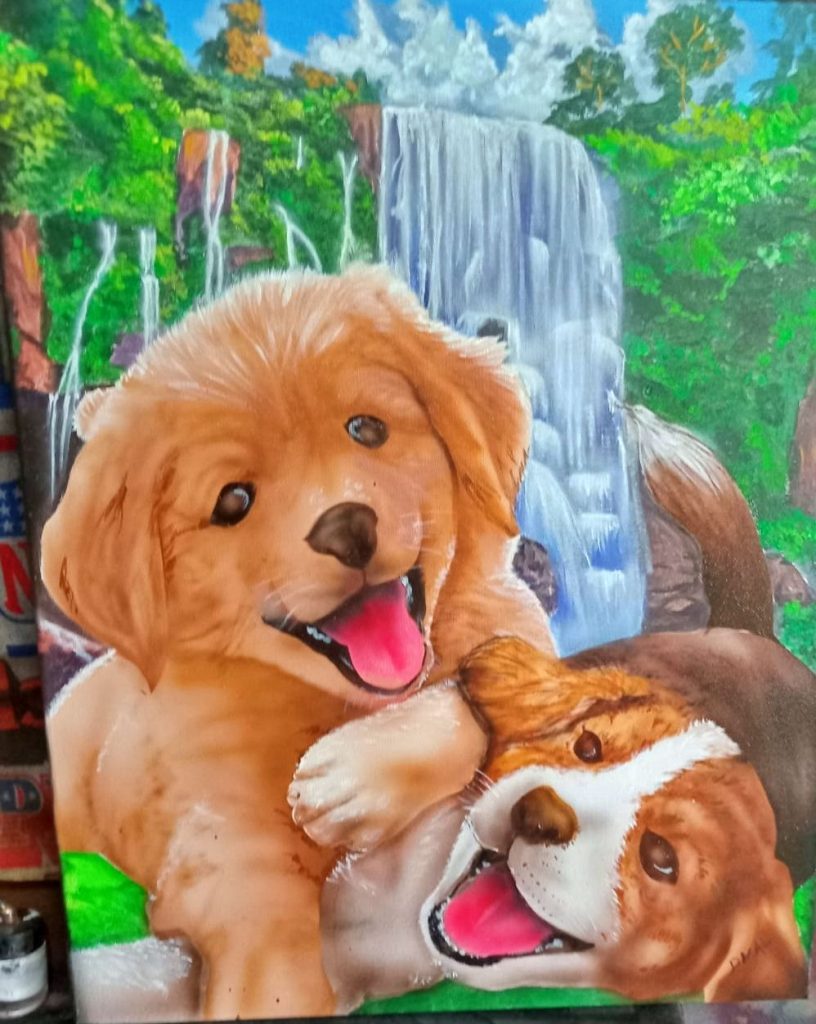
A Trinidad painter’s journey from childhood passion through devastating loss reveals how resilience and adaptation can sustain artistic vision.
David Leehue’s path to becoming a working artist in Trinidad and Tobago began in childhood, shaped by the visual richness of his Henry Street neighbourhood in Port of Spain. Born in 1970, Leehue found early inspiration in Carnival bands and comic books, teaching himself to draw by tracing, colouring and eventually creating original images. At Queen’s Royal College, teacher Jackie Hinkson nurtured his passion and introduced him to art as a discipline, though institutional discouragement after Form Four nearly derailed his ambitions.
Undeterred, Leehue pursued the emerging airbrush scene after leaving school, teaching himself through mentorship and hands-on work. He built a reputation across sign painting, ceramics, T-shirt design and increasingly ambitious commissions—from maxi taxis to gas tank covers to portraits. His ability to deliver quality work quickly made him a sought-after artist in the local creative economy.
On Christmas Eve 2001, a car accident in Barataria shattered that trajectory. Leehue lost his right eye and suffered severe injury to his right arm, compounded by improper initial medical treatment requiring corrective surgery. For an artist whose livelihood depended entirely on hand-eye coordination and vision, the psychological impact was crushing. Depression and fear of destitution followed, though support from the QRC Old Boys Association helped sustain his family through the first difficult year.
Rather than abandon his practice, Leehue rebuilt incrementally. He took whatever work was available while painting whenever opportunity arose, finding particular solace in Carnival body painting. When glaucoma later threatened his remaining eye, he adapted again—enlarging images, using tracing paper and stencils, and shifting toward larger canvases to work within his visual constraints. Technology became an essential ally rather than a limitation.
Today, Leehue measures himself not by what he has lost but by what he continues to create. His artistic confidence has grown, and his message to young artists is unambiguous: never abandon what you love. According to the Trinidad Guardian profile, Leehue believes authentic work will find recognition if the artist persists in seeing and creating, regardless of doubt or circumstance. “Art is what the person looking at it sees,” he reflects. “I see art in everything that’s around me.”
David Leehue’s career spans several decades of Trinidad and Tobago’s visual culture, from the 1990s airbrush and sign-painting scene through contemporary practice. His work has been integral to local Carnival aesthetics and commercial art production, making his personal resilience relevant to understanding how creative practitioners sustain themselves in the Caribbean economy.
Leehue’s story speaks directly to Caribbean artists navigating limited institutional support, economic precarity and the pressure to abandon creative vocations for more stable income. His insistence on continuing despite physical disability and systemic discouragement reflects broader Caribbean narratives about artistic persistence and cultural production in resource-constrained contexts.
Written & Edited by Orlyn Edwards. Published by Caribbean Air Force Media.
Category: Culture · Island routing: Trinidad & Tobago
That’s very cool that’s nice art love it👍