
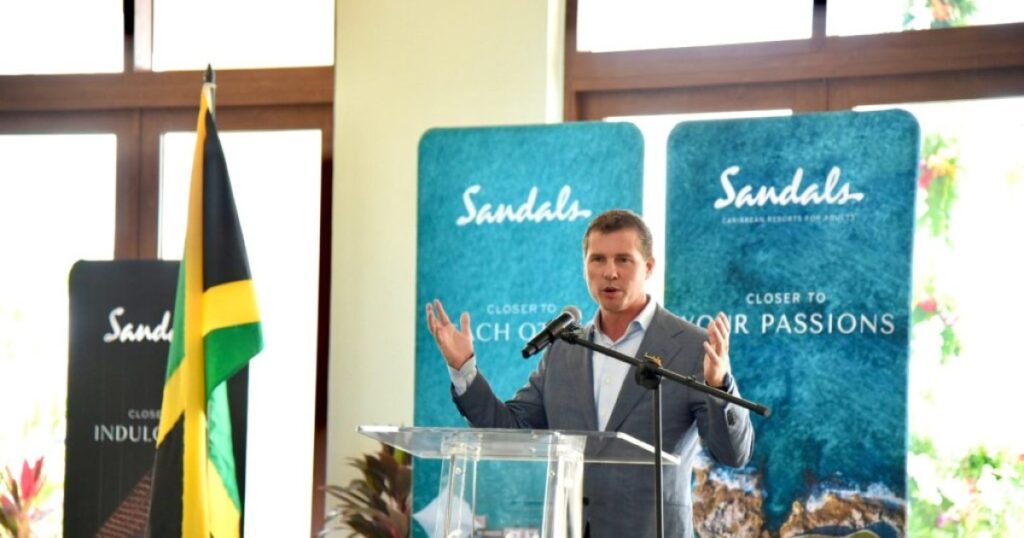
At the official reopening of Sandals South Coast in Whitehouse, Westmoreland, Jamaica’s Minister of State for Industry, Investment and Commerce Delano Seiveright underscored the economic significance of large hospitality operators’ commitment to local sourcing. According to the Jamaica Observer, Seiveright highlighted company figures demonstrating that Sandals purchases 100 per cent of its agricultural produce from local suppliers, with 90 per cent actually farmed within Jamaica—a sourcing strategy he described as demonstrating how major investments can stimulate agriculture, manufacturing, entrepreneurship and wider economic growth.
Seiveright framed each purchase of Jamaican fruits, vegetables, chicken, seafood and other products as creating tangible opportunities for farmers, manufacturers, distributors and countless small businesses. While acknowledging that other major hotel groups also contribute substantially to domestic economic activity through local procurement, he positioned Sandals as more than a hospitality enterprise. "Sandals is not simply a hotel company. It is a Jamaican institution, an economic powerhouse and one of the greatest entrepreneurial success stories this region has ever produced," he declared, according to the Jamaica Observer.
The minister commended Sandals Executive Chairman Adam Stewart and Tourism Minister Edmund Bartlett for their efforts to strengthen connections between hospitality operators and Jamaica’s productive sectors. He also highlighted government support mechanisms, including the Productive Input Relief programme, which provides qualifying manufacturers with duty-free importation of approved production inputs, a 50 per cent reduction in customs administrative fees, and other concessions designed to help Jamaican manufacturers reduce costs and become more competitive suppliers to hotels and other major enterprises.
Seiveright noted that the Sandals South Coast reopening represents a significant economic boost to Westmoreland following Hurricane Melissa’s devastation across western Jamaica. The resort employs approximately 900 to 1,000 people, mostly from surrounding communities, while Sandals operates nearly 7,000 jobs across the island. Beyond employment, the minister praised the company’s investment in workforce development through Sandals Corporate University and community initiatives through the Sandals Foundation, framing the resort operator’s legacy as fundamentally about building Jamaica and creating opportunities for its people.
Sandals Resorts, founded by Gordon "Butch" Stewart, has grown to become one of the Caribbean’s largest hospitality operators. The company’s commitment to local sourcing and employment reflects broader efforts by Jamaica’s government and major private sector actors to strengthen linkages between tourism and domestic agricultural and manufacturing sectors, a strategy aimed at maximizing the economic multiplier effect of the island’s tourism industry.
This story illustrates a model increasingly relevant across the Caribbean: how major multinational hospitality operators can be structured to strengthen rather than bypass local economies. Jamaica’s approach to incentivizing local sourcing through government programmes and private sector partnerships offers a template that other Caribbean nations with significant tourism sectors may study as they seek to ensure tourism investment translates into sustainable domestic economic growth.
Sources and attribution
- Jamaica Observer
- Sandals South Coast reopening brings economic lifeline to Westmoreland
- SANDALS® Sustainability & Corporate Social Responsibility
- Statement to Parliament on the Aftermath of Hurricane Melissa
- JAMAICA CUSTOMS ON THE FRONTLINE: COOPERATION AND COORDINATION BEHIND THE MELISSA RELIEF EFFORT
- [PDF] Caribbean-Focused – LEADERS Magazine