
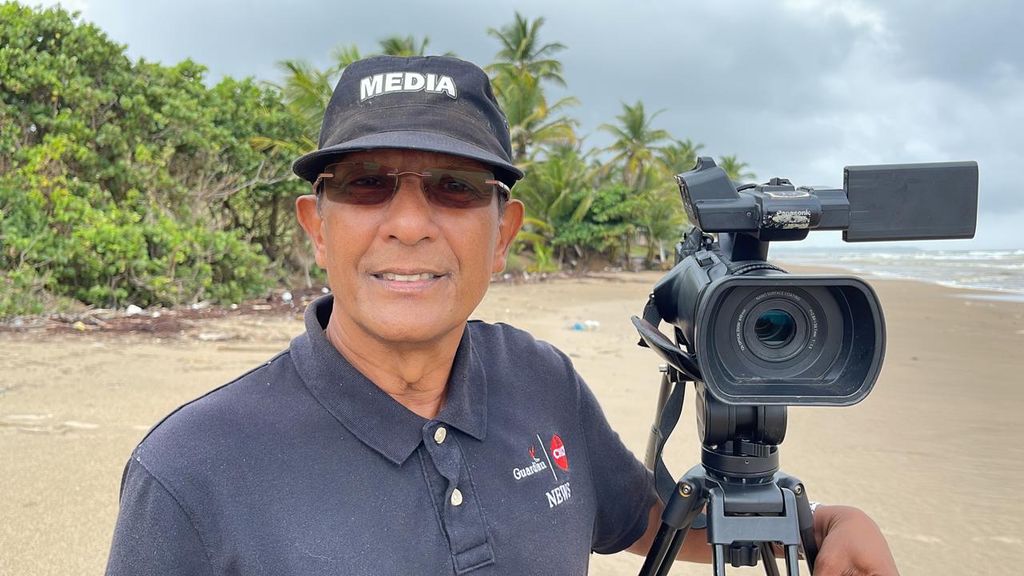
A veteran cameraman reflects on nearly 40 years documenting stories from Trinidad’s forgotten corners—and the price of bearing witness.
Ivan Toolsie’s journey into television began almost four decades ago, shortly after Trinidad and Tobago’s attempted coup in July 1990. Already known in his community as a videographer, he recorded footage of a tragic event and brought it to AVM Television. The station recognized its news value, and when a major industrial fire erupted in South Trinidad, Toolsie captured that too. Soon, television stations were calling him for footage, and he began supplying material to TV6 and TTT, establishing himself as a reliable source of pictures from the region.
When CNC3 prepared to launch in 2005, Toolsie had already built a reputation for reaching difficult stories. Some TV6 staff members moved to the new station and invited him to join them—on one condition: his footage would be exclusive. Toolsie accepted and became part of CNC3’s original team, remaining based in South Trinidad. Over the years, his assignments have taken him into situations most journalists would avoid. He was assaulted by a security guard while documenting conditions at San Fernando General Hospital, yet continued filming. The resulting report prompted rapid improvements at the facility within a day and a half. He also ventured to the aftermath of the 1997 Piparo mud volcano eruption, walking across galvanised sheets to reach the volcano itself and capture images of homes, buildings and livestock buried in mud.
Toolsie’s fearlessness extended beyond land. He travelled by boat with fishermen to investigate a floating mass reported beyond Trinidad’s waters and documented undersea volcanic phenomena—assignments he describes as dangerous but unforgettable. Throughout his career, he has witnessed the transformation of broadcast technology, from U-matic and VHS formats to digital recording cards. Yet he does not view smartphone cameras as competition. Instead, he emphasises the difference between simply capturing video and telling a verified story. “I’m not just going to take a video, whether it’s shaky or not,” he explained, noting that he checks with sources and conducts follow-ups to ensure accuracy.
Much of Toolsie’s work has focused on rural communities across South Trinidad, where residents have used media coverage to highlight problems that might otherwise remain invisible. His philosophy centres on amplifying the voices of those unheard by authorities. “When nobody’s listening to them, I can highlight it and bring it to the relevant people,” he said. This commitment to giving voice to the voiceless shaped his view of CNC3’s role in national conversation. His contributions were recognised nationally in 2025 when he received the Chaconia Medal (Silver) for Film and Media—an honour he described as overwhelming.
Despite the recognition, Toolsie remains clear-eyed about what journalism demands. His advice to young people entering the profession is blunt: do not pursue it for fame or money. “This work is about going out there in the rain and the storm,” he said. “If you don’t have that passion to help people, don’t come in this job.” After nearly four decades behind the lens, his vision of legacy is equally straightforward—to be remembered as someone who cared for his family, helped underprivileged people, and gave voice to the voiceless.
Ivan Toolsie began his television career in the early 1990s, shortly after Trinidad and Tobago’s July 1990 attempted coup. He initially supplied footage to multiple stations including AVM Television, TV6 and TTT before joining CNC3 at its 2005 launch. His career has spanned the evolution of broadcast technology from U-matic and VHS formats to modern digital recording.
Toolsie’s four-decade career exemplifies the role of Caribbean journalists in holding institutions accountable and amplifying marginalized voices. His work documenting conditions at San Fernando General Hospital and rural South Trinidad communities reflects the broader Caribbean media tradition of investigative reporting that drives social change. His 2025 Chaconia Medal recognition underscores the value Trinidad and Tobago places on committed journalism.
Written & Edited by Orlyn Edwards. Published by Caribbean Air Force Media.
Category: Technology · Island routing: Trinidad & Tobago