
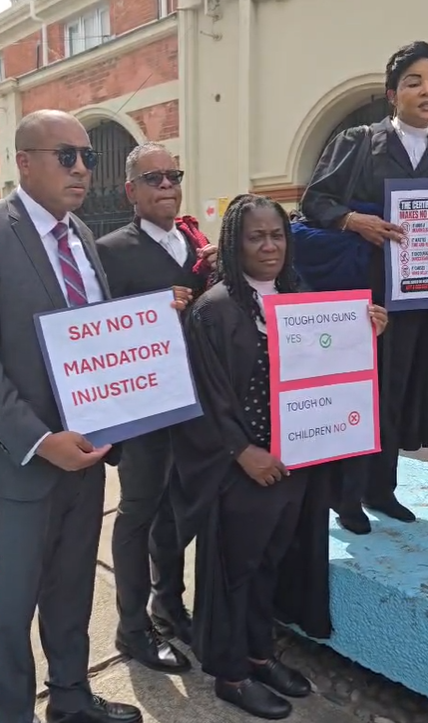
Defence attorneys staged a silent protest at Kingston’s Supreme Court, arguing that rigid 15-year minimum sentences undermine judicial fairness and individual case assessment.
Jamaica’s legal profession took to the streets on Wednesday with a pointed message: tough sentencing for gun crimes need not mean removing judges’ ability to consider individual circumstances. Defence attorneys dressed in black gathered outside the Supreme Court in downtown Kingston for a silent demonstration, carrying placards with slogans including “Tough on guns: yes. Tough on children: no,” according to the Jamaica Observer.
The protest centred on the Firearms (Prohibition, Restriction and Regulation) Act of 2022, which mandates 15-year minimum sentences for certain firearms offences. Members of the legal profession have grown increasingly concerned that these rigid requirements prevent judges from distinguishing between different offenders and the unique facts of each case. The demonstration reflects a broader unease within sections of the bar about the law’s impact on judicial independence.
King’s Counsel Peter Champagnie, a prominent participant, stressed that the attorneys’ position should not be mischaracterised as soft on crime. “Yes, crime is down, and we are happy for that, but this is more than that,” he said, pushing back against suggestions that lawyers opposing mandatory minimums are aligned with criminal interests. Champagnie noted that the Office of the Director of Public Prosecutions has similarly called for a legislative review—a historic alignment between the defence bar and prosecutors.
Tenneshia Watkins, President of the Jamaican Bar Association, emphasised that judges trained to assess cases competently should be trusted to do so. She argued that a functioning justice system must address matters proportionately and on their individual merits, rather than applying one-size-fits-all sentences. The attorneys framed their position as a defence of the separation of powers, contending that the legislature should not restrict the judiciary’s traditional role in sentencing.
Justice Minister Delroy Chuck has indicated that repealing mandatory minimums remains unlikely, citing security forces’ credit for the law in reducing murders and shootings. However, the unified call from defence attorneys, prosecutors, and bar leadership suggests momentum may be building for at least a formal review of how the legislation functions in practice.
Jamaica enacted the Firearms (Prohibition, Restriction and Regulation) Act in 2022 as part of efforts to combat gun violence. The legislation introduced mandatory minimum sentences of 15 years for specified firearms offences, removing judicial discretion in sentencing for these crimes.
Jamaica’s debate over mandatory minimum sentencing reflects broader Caribbean tensions between public safety imperatives and judicial fairness. As Caribbean nations grapple with gun violence, this case illustrates how regional legal systems balance crime-fighting measures with the rule of law and individual rights—issues affecting courts and communities across the region.
Written & Edited by Orlyn Edwards. Published by Caribbean Air Force Media.
Category: News · Island routing: Jamaica