
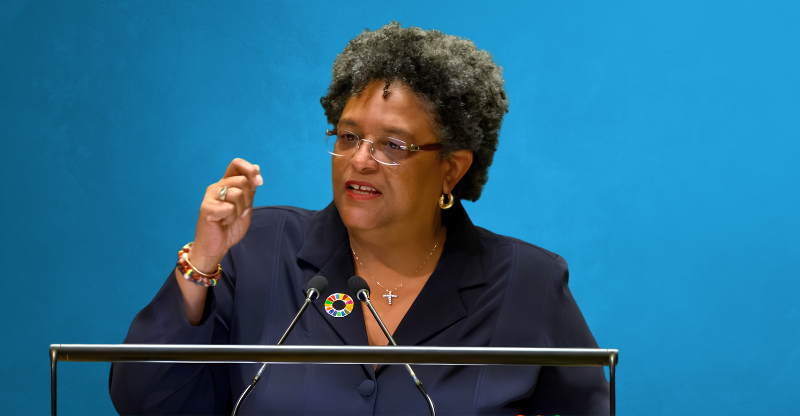
Prime Minister Mottley announces technical committee of historians and economists to calculate compensation, urging regional leaders to move beyond advocacy to concrete strategy.
Barbados is taking a significant step toward quantifying its reparations claim, with Prime Minister Mia Mottley announcing the formation of a technical committee comprising historians and economists. Speaking at the CARICOM Regional Conference on Reparations at the Wyndham Resort Sam Lord’s Castle, Mottley emphasized that strong evidence will be essential for presenting Barbados’ case effectively, and she encouraged other Caribbean nations to undertake similar research efforts.
Mottley’s remarks reflected a broader frustration with the pace of the reparations movement. She argued that Caribbean governments must demonstrate the moral leadership necessary to advance reparatory justice, contending that the region should move beyond simply advocating for reparations and instead focus on building concrete cases backed by rigorous documentation. “We need to stop being just advocates of a movement, and become advocates of a case,” she stated, calling for unity among nations on a clear path forward rather than allowing disagreements over details to derail progress.
The Prime Minister also proposed a global petition campaign spanning six to twelve months to gather signatures from around the world, framing public support as essential to the movement’s success. She highlighted the historical precedent of Britain’s compensation to slave owners—nearly £20 million in 1834, equivalent to approximately £200 billion in contemporary currency—as evidence that wealthy nations possess the capacity to address historical wrongs. Mottley criticized what she characterized as hypocrisy among some countries, suggesting they prioritize convenience over moral responsibility.
Mottley expressed concern about waning grassroots participation in the reparations movement across the Caribbean and Africa, despite the campaign’s origins in community-led efforts. She also cautioned against allowing global distractions to undermine the work of the CARICOM Reparatory Commission and other reparations groups. The Prime Minister connected the reparations push to broader global crises, noting that the Caribbean continues to suffer economic and climatic challenges it did not create, and arguing that the world requires a stronger moral center to address these interconnected problems.
The CARICOM Regional Conference on Reparations, themed “The Global Reparatory Justice Movement: Charting the Way Forward,” brought together regional leaders and reparations advocates to advance the Caribbean’s campaign for compensation related to slavery and colonialism. The reparations movement has gained momentum in recent years, with the Black Lives Matter movement in the United States providing additional impetus to the cause.
This development is central to Caribbean interests, as it represents a formal commitment by a major regional government to advance the reparations agenda through evidence-based research. The establishment of Barbados’ technical committee could serve as a model for other Caribbean nations and strengthen the collective CARICOM case for reparatory justice from former colonial powers.
Written & Edited by Orlyn Edwards. Published by Caribbean Air Force Media.
Category: News · Island routing: Barbados