
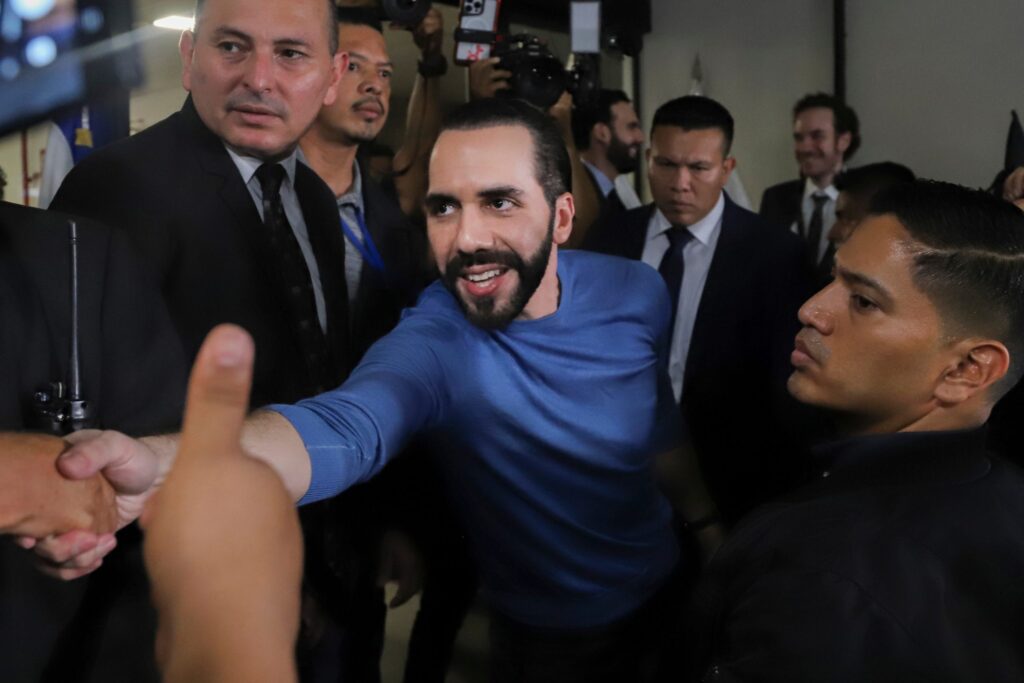
El Salvador’s Nayib Bukele took the stage Thursday night to officially declare his candidacy for a third consecutive term, cementing a political trajectory that has fundamentally reshaped his nation’s democratic institutions. According to reporting from the Associated Press via The Haitian Times, the populist leader submitted his paperwork to the country’s Supreme Electoral Tribunal, buoyed by approval ratings hovering near 90%—a level of support rooted largely in his aggressive gang crackdown that has reduced violence but sparked serious human rights concerns.
Bukele’s path to a third term required years of institutional maneuvering. His New Ideas party, which holds a supermajority in congress, cleared the way for his candidacy in July after a Supreme Court stacked with his loyalists ruled in his favor. A 2025 congressional reform then eliminated presidential term limits altogether, a move that fundamentally altered El Salvador’s constitutional framework. Political observers and opposition figures have called the bid illegal, yet acknowledge Bukele’s genuine popular support among Salvadorans weary of gang violence.
The reelection campaign unfolds against the backdrop of an expanding military footprint beyond El Salvador’s borders. Bukele has deployed roughly 2,500 troops to Haiti following the October disappearance and killing of four Salvadoran aviation technicians in a gang attack. Critics contend the Haiti offensive serves multiple purposes: deflecting international scrutiny of his domestic record, rallying nationalist sentiment ahead of elections, and advancing his broader political consolidation. Human Rights Watch’s Juan Pappier characterized the situation starkly, noting that Bukele has achieved "absolute concentration of power" through court-packing, constitutional rewriting, and the imprisonment or exile of critics.
The February elections will test whether Salvadorans continue to prioritize security over democratic norms. Many citizens have expressed willingness to trade democratic freedoms for relief from gang violence—a calculation that has rendered traditional opposition parties nearly irrelevant. Bukele’s government has simultaneously pressured watchdog organizations and journalists, prompting what observers describe as the largest civil society exodus since El Salvador’s civil war decades earlier. With no meaningful political challenger on the horizon, the sitting president appears positioned to secure another term with ease.
El Salvador’s Constitution historically prohibited consecutive presidential reelection, a safeguard rooted in the nation’s fragile democratic recovery following its devastating civil war. Bukele, who took office in 2019 as a political outsider, has systematically dismantled these checks and balances over his first two terms, concentrating executive power while his party controls congress.
The deployment of Salvadoran military forces to Haiti represents a significant foreign intervention in Caribbean affairs, raising questions about regional stability and the precedent for military action across borders. For Haiti, already struggling with gang violence and political instability, the presence of foreign troops introduces complex sovereignty and security dynamics relevant to broader Caribbean geopolitics.