
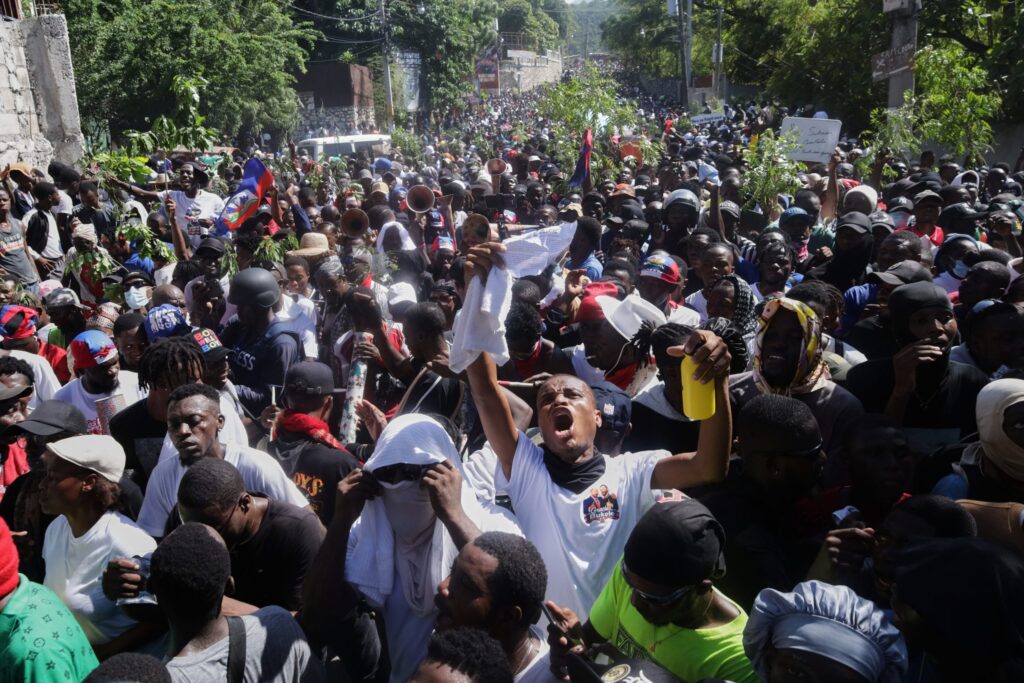
Thousands of residents flooded the streets of Port-au-Prince on Tuesday to express support for El Salvador’s President Nayib Bukele and the Salvadoran military contingent deployed to combat gang violence, according to The Haitian Times. Demonstrators raised their fists, waved Haitian flags, and held signs backing the troops, with some calling for additional resources including drones and robot dogs already in use against gang strongholds.
Bukele dispatched approximately 2,500 troops to Haiti last month following an attack on October 18 that left four Salvadoran soldiers missing. The deployment reflects growing frustration with the pace of international efforts to address gang violence that has claimed more than 20,000 lives over the past five years and left gangs controlling roughly 70 percent of the capital.
Yet beneath the public enthusiasm lies a troubling reality: Haiti has no coherent strategy for maintaining security once foreign forces depart. The International Crisis Group, in a report released Tuesday based on over 100 interviews with officials in Haiti and internationally, found that the government lacks basic institutional capacity to sustain gains. The group noted that a National Security Council proposed two years ago to develop long-term strategy never materialized, partly because officials feared intelligence functions could be weaponized against political rivals.
Haiti’s National Police force faces severe constraints, with fewer than 8,000 active officers serving a nation of nearly 12 million people. The government compressed police training from seven months to less than four months to rapidly expand the force, and many officers lack combat preparation. Lower-ranking officers earn approximately $300 monthly before deductions, creating incentives for some to work with gangs or turn to private security and arms trafficking.
While Haitians have embraced the use of explosive drones and helicopter support—capabilities their own security forces lack—the International Crisis Group cautioned that such weapons have produced "diminishing returns" without meaningful territorial gains or shifts in the balance of power. The report acknowledged the appeal of drones in a security environment as dire as Haiti’s, but warned that an immediate ban, while unrealistic, should eventually give way to stronger oversight and institutional development.
Salvadoran Vice President Félix Ulloa stated Monday that the bilateral agreement governing the mission would remain confidential, citing a "hidden agenda to criticize our operation" when questioned about human rights safeguards. Salvadoran officials indicated troops would remain until the four missing aviation technicians are located.
Haiti has endured decades of gang violence, political instability, and institutional weakness. The deployment of Salvadoran forces represents one of the most significant foreign military interventions in recent years, following years of limited effectiveness by UN-backed missions and Haiti’s own underfunded security apparatus.
This story directly affects Haiti and the broader Caribbean region, where gang violence and institutional collapse create humanitarian crises and regional instability. The deployment of Salvadoran forces and the debate over foreign intervention versus domestic capacity-building reflects broader questions about security governance across the Caribbean and the role of external actors in addressing endemic violence.