
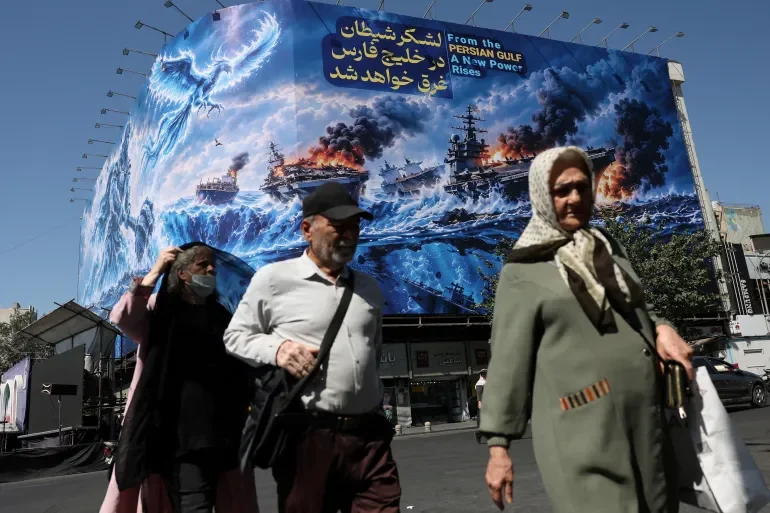
Escalating maritime attacks and competing claims over shipping control signal deeper entrenchment in the U.S.-Iran standoff.
The diplomatic window between Washington and Tehran appears to have closed entirely, leaving the strategically vital Strait of Hormuz in a state of heightened tension. According to reporting carried by Kaieteur News, hours after President Trump rejected Iran’s diplomatic proposal, explosions were reported near Qeshm Island in the waterway, with Iranian media suggesting that multiple antiship missiles and drones were fired at vessels transiting against Tehran’s wishes.
Iran’s Islamic Revolutionary Guard Corps continues to assert control over the passage, insisting that any ship must coordinate with Iranian authorities. The country has instructed shipping companies to use Iranian-approved routes and pay associated fees, while warning that full reopening of the strait will not occur until the U.S. blockade on Iranian ports is lifted. Last week, an Indian cargo ship was attacked in the waters, resulting in the death of a sailor, underscoring the real human cost of the standoff.
Washington maintains that its naval forces are successfully redirecting oil tankers through alternative routes, with U.S. Energy Secretary Chris Wright claiming that nearly 13 million barrels of crude oil per day are transiting safely. The U.S. military has also stated it has redirected 122 commercial vessels and halted all Iranian crude exports through its blockade. However, Tehran disputes these claims, arguing that Washington is providing false information to project control over the waterway.
Experts warn that the situation is likely to deteriorate further. Andreas Krieg, an associate professor at King’s College London, told Al-Jazeera that Iran’s maritime attack strategy is spreading the economic costs of conflict beyond its borders. Rather than leading to Iranian submission, he argues, the pressure may prompt more aggressive Iranian responses, including increased vessel interdictions, attacks on energy infrastructure, and coordinated pressure through allied groups in the Red Sea and against Saudi export routes.
At the United Nations General Assembly, Iran proposed reopening the strait within a week if seven conditions were met, including lifting the U.S. blockade, releasing frozen Iranian funds, and ending attacks on all fronts. Trump rejected the offer, but Iran’s Foreign Minister Abbas Araghchi indicated Tehran remains committed to these conditions and will await an official response through mediators including Pakistan, Qatar, and Oman.
Krieg predicted that rather than a return to massive air campaigns, the coming weeks will likely see a pattern of controlled attrition—further attacks on tankers and regional infrastructure followed by limited U.S. strikes against Iranian maritime assets. This tit-for-tat cycle, he noted, has already re-emerged around Hormuz, suggesting a prolonged period of instability in one of the world’s most critical shipping lanes.
The Strait of Hormuz has been a flashpoint since the U.S. and Israel began military operations against Iran on February 28, 2026. The waterway is crucial to global energy supplies, and control over its transit routes has become central to the broader geopolitical conflict in the region. Iran’s ability to disrupt shipping through the strait gives it significant leverage despite facing a U.S. naval blockade and economic sanctions.
While the Strait of Hormuz is geographically distant from the Caribbean, disruptions to global oil supplies and shipping routes have direct implications for Caribbean economies and energy costs. Any prolonged instability affecting crude oil transit could influence fuel prices and shipping costs for Caribbean nations dependent on energy imports and maritime trade.
Written & Edited by Orlyn Edwards. Published by Caribbean Air Force Media.
Category: Business · Island routing: Guyana